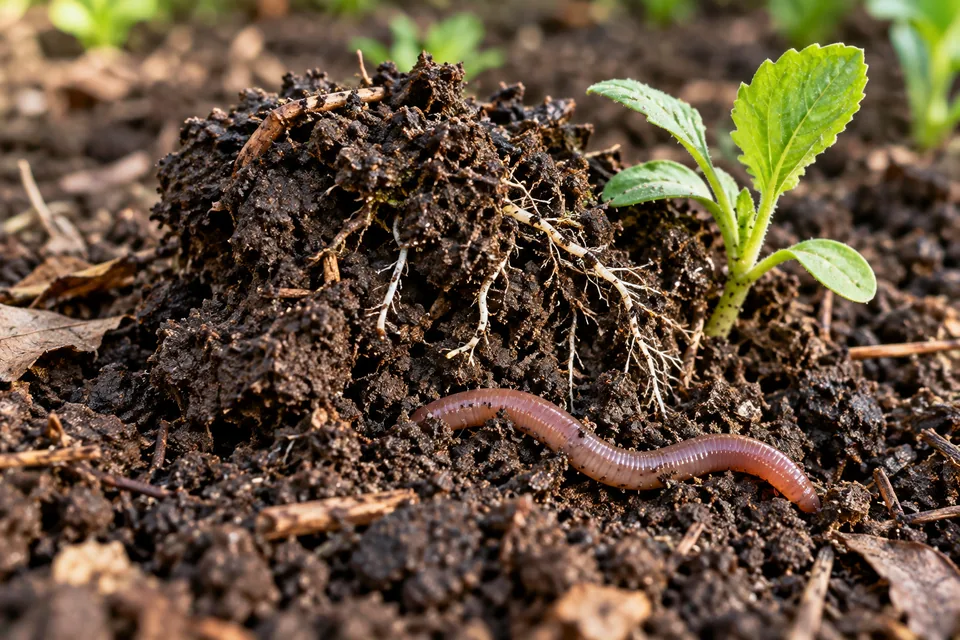
If wet soil sticks to your boots and summer soil cracks like pottery, you may have heavy clay. It can be frustrating, but it is not bad soil. Clay holds water and nutrients exceptionally well. The difficulty is getting enough air, roots, and drainage through its very small pores—especially after the soil has been compacted.
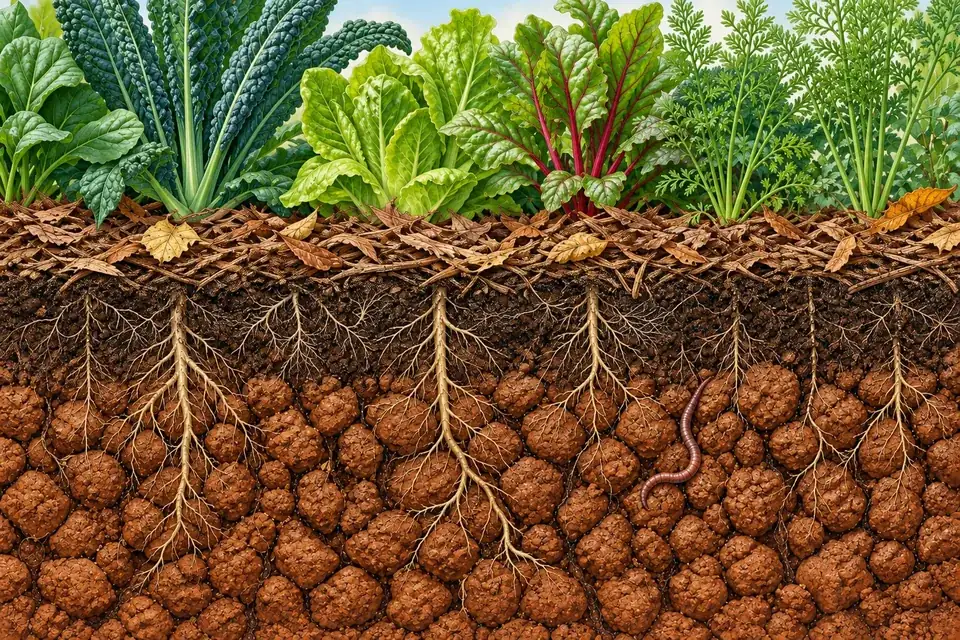
The durable solution is a system, not a product: keep weight off the bed, feed it from the surface, keep it covered, and let living roots build channels downward. This guide explains how to do that without turning or pulverizing the soil.
The short answer
For an ordinary in-ground garden with heavy clay:
- Test before amending. Get a laboratory soil test and check how water moves through the site.
- Create permanent beds and paths. Make each bed narrow enough to reach from both sides, and never step in it.
- Top-dress with finished compost. Start with about 2 inches on intact topsoil; use more only when the soil is severely depleted and test results permit it.
- Cover the surface. Use shredded leaves, clean straw, or other loose organic mulch in annual beds; use coarse arborist chips in paths and perennial beds.
- Keep roots growing. Grow vegetables, flowers, perennial plants, or cover crops for as much of the year as climate allows.
- Leave healthy roots behind. Cut spent plants at soil level rather than pulling the root system out.
- Stay off wet clay. If a handful forms a sticky ball and smears, postpone the work.
Clay texture is permanent. Clay structure is not.
Gardeners often use clay, compaction, and poor drainage as if they were the same condition. They are related, but separating them prevents expensive mistakes.
- Texture is the proportion of sand, silt, and clay particles. At garden scale it is essentially permanent.
- Structure describes how those particles gather into aggregates, or crumbs, and how pore spaces connect around them. Structure can improve or collapse.
- Compaction is damage caused when traffic or tools press aggregates together, reducing the large pores that admit air and transmit water.
- Drainage describes where excess water can go. Structure influences it, but topography, a high water table, and restrictive subsoil layers may control it more strongly.
Clay particles carry electrical charges and have enormous surface area, so they hold nutrients and water well. The same small particles pack tightly, however. A productive clay soil needs stable aggregates: groups of particles bound by organic compounds, roots, fungal threads, and microbial activity. Spaces around those aggregates become the larger pores that roots and oxygen need.
This is why the goal is not to “break up clay” once. It is to support the biological and physical processes that continually rebuild aggregates while avoiding the actions that destroy them. For a broader foundation, see our guide to soil texture, structure, pH, and testing.
What the evidence shows—and what it does not
No-till is often described as if putting away a tiller automatically loosens soil. Research is more interesting than that.
A global meta-analysis of 419 studies found that no-till increased mean aggregate size, water-stable aggregates, and macroaggregates compared with conventional tillage. It also found slightly lower total porosity, substantially less macroporosity in some layers, and lower saturated hydraulic conductivity at some depths. In other words, no-till generally preserved aggregates, but water movement did not improve everywhere.
A long-term silty-clay-loam field experiment in South Dakota illustrates the same tension: no-till raised surface organic matter and wet aggregate stability, but also raised surface bulk density and lowered field-saturated hydraulic conductivity. That is one site, not a universal forecast, but it is a useful warning against “no-till and wait.”
Living roots strengthen the system. A 2025 global cover-crop analysis reported average improvements in water-stable aggregates, porosity, penetration resistance, and infiltration. Fine- and medium-textured soils showed useful responses, although climate, biomass, plant family, and management changed the outcome.
Organic amendments supply the carbon that roots and soil organisms work with. A global analysis of organic amendments and aggregation found improvements in large aggregates and aggregate stability; compost performed especially well.
No-till is not a single action. It is a soil-building system: less disturbance, continuous cover, plant diversity, living roots, and controlled traffic.
Those are also the central USDA Natural Resources Conservation Service soil-health principles. Field-scale percentages are not promises for a home garden, but the direction is consistent: protect aggregates, add carbon, grow roots, and prevent new compaction.
Diagnose the real problem first
Do these checks before ordering a truckload of anything. Record the results so you can repeat them next year.
Get a laboratory soil test
Request pH, organic matter, phosphorus, potassium, calcium, and magnesium. Add soluble salts when manure or compost has been used heavily. In arid regions or where irrigation water leaves white crusts, ask whether sodium, exchangeable sodium percentage, or sodium adsorption ratio should be tested. In an older urban garden, include lead.
A nutrient-rich clay soil may need structure, not fertilizer. A test prevents unnecessary lime, gypsum, manure, and compost applications. Penn State recommends testing clay soil approximately every three to four years, or sooner when a problem develops. Use a regional laboratory whose recommendations are calibrated for local soils. See Penn State's sampling guidance.
Watch the site during rain
Find out whether water is failing to enter the surface, entering slowly, or entering and then meeting a saturated or restrictive layer. Note roof downspouts, pavement runoff, low areas, slopes, and where water remains the next day.
Run a drainage test
University of Maryland Extension suggests a 12-inch-deep, 12-inch-wide hole. Fill it with water, let it saturate overnight, refill it, and measure the drop. If all the water has not drained within about eight hours—or the rate is below roughly 1 inch per hour—the cause could be clay, compaction, buried construction debris, a restrictive layer, or a high water table. The test identifies a symptom; it does not identify the cause by itself.
Check resistance and roots
A few days after rain, when the ground is moist rather than wet, push a stiff steel rod downward. Repeated resistance at the same depth suggests a compacted or naturally dense layer. Inspect roots from an existing plant: roots that abruptly turn sideways or remain in a shallow pancake are valuable evidence.
Use the squeeze test before every job
Squeeze soil from several inches down. If it molds into a sticky ball, takes fingerprints, or smears into a ribbon, do not walk, plant, fork, or haul materials across the bed. If it breaks into smaller crumbs when bounced or pressed, conditions are safer.
The five-part no-till plan
Each part solves a different weakness. Leaving one out is why many no-dig beds stall.
- Control traffic. Permanent paths protect the growing soil from feet, carts, and hoses.
- Feed the surface. Finished compost supplies stable organic material without destroying existing structure.
- Keep armor on the soil. Mulch or plant cover absorbs raindrop impact, suppresses weeds, and limits crusting.
- Maintain living roots. Roots feed organisms, press into small weaknesses, and leave pores when they decay.
- Manage water as a site problem. Slow irrigation, runoff control, and raised growing areas solve conditions that organic matter alone cannot.
Think in layers rather than ingredients mixed in a bowl. Forest and grassland soils build largely from the top down: residues land at the surface; organisms process them; roots contribute carbon at depth. A garden can use the same pattern while still allowing narrow planting holes and seed rows.
Build a new no-dig bed on clay
Autumn is the easiest time because moisture helps layers settle and decomposition can begin before spring, but the method works whenever the ground is not saturated or frozen.
- Lay out beds 3 to 4 feet wide. You should reach the center without placing a knee or foot on the bed. Establish permanent paths before moving materials.
- Cut existing growth low. Leave clean clippings in place. Remove seed heads, diseased material, and vigorous perennial weeds that readily grow through mulch.
- Use cardboard only when it solves a turf or weed problem. Lay one overlapping layer of plain brown corrugated cardboard, remove tape and staples, and soak it. Skip cardboard over bare soil, around established plants, or where drainage is already marginal.
- Add finished plant-based compost. Two inches is a sensible starting layer over intact topsoil. Use 3 to 4 inches only on badly depleted or thin topsoil when the nutrient and salt analysis supports it.
- Add a loose mulch. Use 2 to 3 inches of shredded leaves or clean straw in an annual vegetable bed. Put 4 to 6 inches of coarse chips on paths.
- Plant through the layers. Transplants are forgiving in the first season. Open only the hole required, seat the root ball firmly against moist soil, water it, and return mulch without touching the stem.
- Keep every bed occupied. Follow harvested crops with another crop, flowers, or a locally appropriate cover crop.
| Compost depth | For 100 sq. ft. | For 1,000 sq. ft. |
|---|---|---|
| ½ inch | 4.2 cu. ft. | 1.5 cu. yd. |
| 1 inch | 8.3 cu. ft. | 3.1 cu. yd. |
| 2 inches | 16.7 cu. ft. | 6.2 cu. yd. |
| 3 inches | 25 cu. ft. | 9.3 cu. yd. |
University of Maryland Extension gives 8.33 cubic feet per 100 square feet for a 1-inch layer and notes that about 1 inch annually can maintain productive vegetable and flower beds. Treat that as an upper maintenance guideline, not an automatic prescription: phosphorus, salts, pH, and existing organic matter still govern the rate.
If construction removed the topsoil, consider an open-bottom raised bed filled with a tested mineral topsoil–compost blend. Pure compost shrinks as it decomposes and is not a durable substitute for mineral soil. Do not put an impermeable liner beneath the bed.
Choose materials by job, not by reputation
| Material | Best use | Watch for |
|---|---|---|
| Plant-based finished compost | Initial surface layer and light annual top-dressing | High phosphorus or salts after repeated applications |
| Shredded deciduous leaves | Annual beds, winter cover, around established vegetables | Whole wet leaves can mat; shred or mix textures |
| Leaf mold | Low-nutrient surface organic matter | Limited fertility; that is often an advantage |
| Clean straw | Summer vegetable mulch | Weed seeds and persistent herbicides in the source crop |
| Dried grass clippings | Thin layers around established crops | Wet mats become slimy; confirm no lawn herbicides |
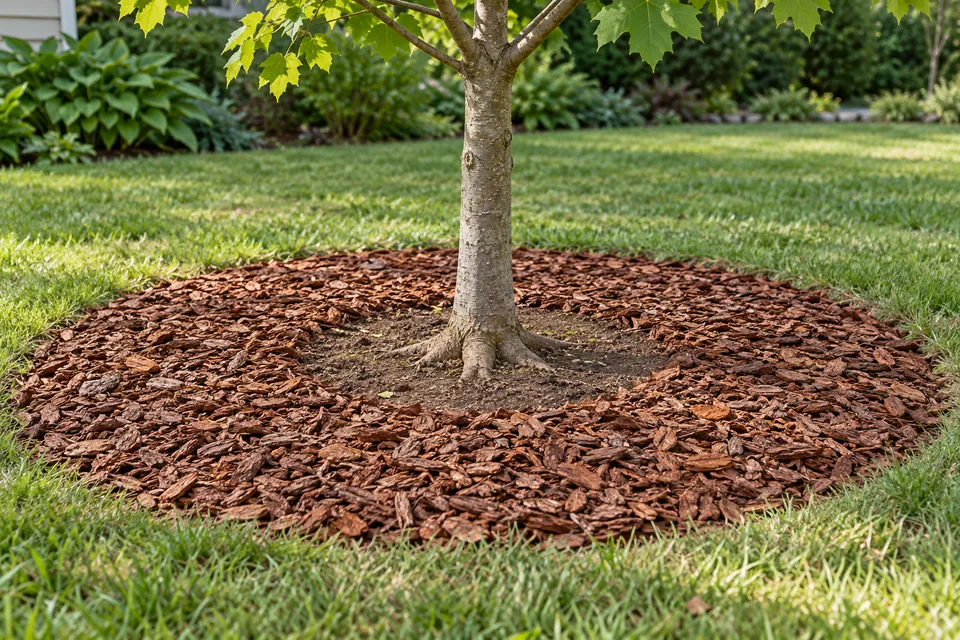
| Coarse arborist chips | Paths, trees, shrubs, berries, perennial beds | Keep off crowns and trunks; do not mix into soil |
| Composted manure | A measured nutrient source when a test calls for it | Phosphorus, salts, pathogens if immature, and herbicide residue |
| Cardboard | One-time suppression of turf or annual weeds | Thick layers restrict air and water; persistent weeds may penetrate |
Compost quality matters
Finished compost should smell earthy, remain near ambient temperature, and contain no recognizable food scraps. Ask a bulk supplier for a recent analysis. Yard-trimming or leaf compost generally adds less phosphorus and salt than manure-based or mushroom compost.
Persistent pasture herbicides such as aminopyralid and clopyralid can survive in hay, animal manure, and finished compost at concentrations that injure beans, peas, tomatoes, and other broadleaf crops. Before spreading an unfamiliar bulk load, grow peas in a mixture of the material and clean potting medium alongside an untreated control. Distorted, cupped new growth is a warning. Oregon State Extension explains the bioassay and contamination pathway.
Keep wood on top
Microorganisms need nitrogen while decomposing carbon-rich wood. When chips are buried, that competition occurs throughout the root zone. When chips remain on top, it is largely confined to the soil–mulch boundary. Washington State University's research review recommends coarse arborist chips as a long-lasting landscape mulch and reports strong weed control at a maintained 4- to 6-inch depth.
Use cardboard sparingly
Cardboard is useful for converting lawn, but it is not the engine of soil improvement. Research has measured much lower gas diffusion through cardboard than through wood chips, although short-term soil oxygen was not significantly different from bare soil in the controlled experiment. Read the mulch gas-exchange study. Oregon State also warns that thick cardboard creates an interface that can restrict water and air. Use a single soaked layer for a defined purpose, cover it immediately, and do not repeat it as an annual ritual.
Do not import earthworms
Create food and habitat for the organisms already present. Purchased worms are not required, and soil or compost can move invasive jumping-worm cocoons. Check local guidance before moving mulch, plants, or compost between properties. University of Minnesota Extension maintains current prevention guidance.
Likewise, bottled microbial communities, compost tea, and general mycorrhizal inoculants do not supply the carbon needed to restructure clay. A crop-specific rhizobium inoculant for a legume is a different, targeted tool; most established garden soils already contain diverse organisms, and habitat is the more dependable investment.
Use roots as biological tillage
Cover crops protect bare beds, feed soil organisms, stabilize aggregates, and leave pores after their roots decay. Grasses contribute dense fibrous roots; brassicas contribute thicker taproots; legumes can add biologically fixed nitrogen when paired with the correct rhizobia.
The easiest cover crop is not necessarily the one with the deepest root. It is the one you can establish and terminate without tilling or allowing it to become a weed.
| Cover crop | What it contributes | No-till termination | Main caution |
|---|---|---|---|
| Spring oats | Beginner-friendly fibrous roots and quick cover | Winterkill in reliably cold climates | May survive a mild winter |
| Forage or daikon radish | Thick taproot and useful root channels | Usually winterkills after sustained hard freezes | Plant early; rotate with other brassicas |
| Oats + forage radish | Fibrous surface network plus deeper channels | Leave winterkilled residue in place | Thin stands give little benefit |
| Winter wheat | Hardy roots and moderate biomass | Cut, crimp, or smother in spring | Must be killed before seed; may regrow |
| Cereal rye | Exceptional root mass and long-lasting mulch | Crimp near pollen shed, or mow and smother | Hard to kill early; mature residue can immobilize nitrogen |
| Crimson clover | Nitrogen fixation and plant diversity | Cut near flowering or smother | Winter survival varies |
| Hairy vetch | Substantial nitrogen potential | Crimp near early pod stage | Can become a persistent weed if it seeds |
| Buckwheat | Very fast summer cover and flowers for insects | Cut at flowering, before seed | Frost-sensitive and not deep-rooted |
For a first attempt in a cold-winter climate, oats mixed with forage radish is relatively low-risk because winter can perform the termination. In mild climates, do not assume either species will die.
University of Maryland's home-garden rates per 100 square feet are 3 to 4 ounces for oats, rye, wheat, or buckwheat; 1 to 2 ounces for forage radish or crimson clover; and 3 to 4 ounces for hairy vetch. For a two-species mixture, it recommends roughly 60 percent of each full rate.
Move existing mulch aside, broadcast before rain, press the seed firmly against the surface, and cover only as deeply as that species requires. This slight planting disturbance is compatible with no-till; poor seed-to-soil contact on hard clay produces a patchy stand that cannot protect or improve the bed.
In spring, leave winterkilled residue as mulch. For a living cover, cut or crimp at the correct reproductive stage. At garden scale, mowing followed by two to three weeks beneath an opaque reusable tarp can finish plants that would otherwise regrow. Do not let a cover crop make viable seed.
Forage radish is helpful, not a biological crowbar. Maryland field trials found that some spring vegetables succeeded after winterkilled radish without tillage while results varied by soil and crop. Poorly aggregated, low-organic-matter soil may need several years of soil-building before direct seeding becomes reliable.
Plant and harvest without resetting the soil
No-till does not prohibit every hole. It avoids wholesale inversion, mixing, and pulverization.
- For transplants: move mulch aside, open a hole only slightly wider than the root ball, firm soil against the roots, water, and return mulch without touching the stem.
- For small seeds: clear a narrow row and add ½ to 1 inch of screened compost if the surface is too coarse. Sow into that strip and mulch beside it after emergence.
- For potatoes and squash: use a compost-rich mound or pocket during the first transition season rather than repeatedly opening the entire bed.
- At harvest: cut healthy plants at the crown. Leave roots and root-associated soil in place.
- For diseased roots: remove them when the disease's life cycle or local Extension guidance calls for sanitation.
Transplants, beans, squash, tomatoes, chard, kale, and potatoes are generally more forgiving in a new no-dig bed than straight, unbranched carrots or parsnips. That is a transition issue, not a permanent ban on root crops.
Mulch can shelter slugs, voles, and cutworms. Check beneath it rather than abandoning it. Pull mulch a few inches back from vulnerable seedlings, eliminate dense cover immediately against woody stems, and use the least disruptive targeted control.
Manage water slowly—and know the drainage limit
Clay accepts water slowly and releases it slowly. Fast irrigation often runs away while the soil beneath remains dry; frequent irrigation can keep pores full and roots oxygen-starved.
- Use drip tubing or a soaker hose beneath mulch.
- Apply water slowly. Split a long irrigation into two cycles if runoff begins.
- Check moisture beneath the mulch before watering again.
- Water new transplants until roots connect with the native soil; do not assume damp mulch means a wet root ball.
- During a cool, wet spring, pull mulch away from direct-seeding rows so the surface can warm and dry.
- Return mulch after seedlings establish and warm weather arrives.
Our water-wise gardening guide explains how to use feel, root depth, and plant stage rather than a fixed calendar.
When to raise the bed
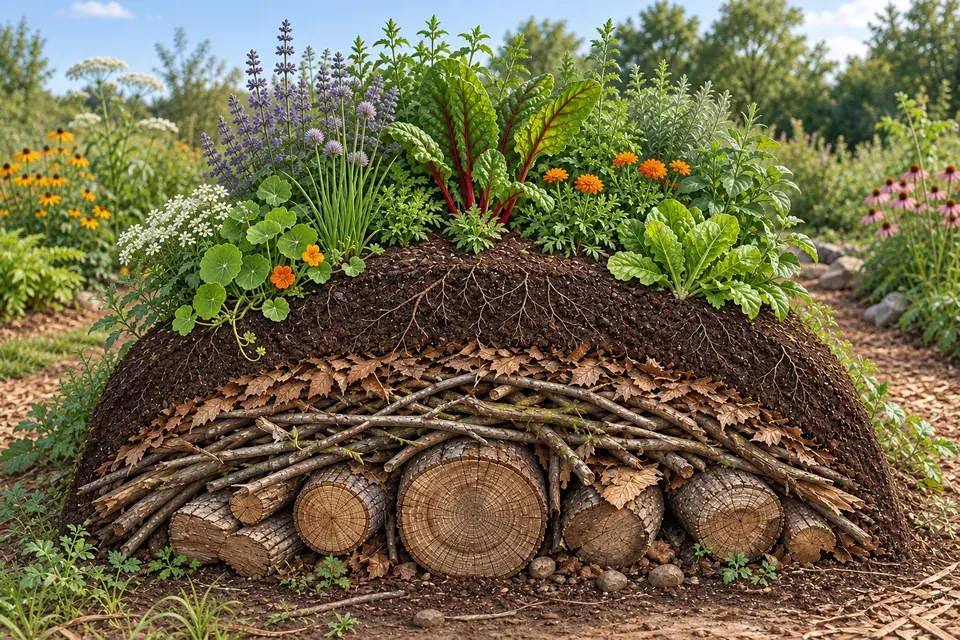
If water remains after the drainage test, roots smell sour, or the site is predictably saturated for long periods, build upward. An open-bottom mound or raised bed gives vegetables an aerated root zone while deeper roots gradually explore the clay. Use tested loam or topsoil blended with mature compost, not a box of pure compost.
Raised beds dry faster in summer, settle, and require imported material, so they are a bypass rather than proof that the underlying drainage has been repaired. If the entire area receives runoff or sits over a high water table, correct that site problem first.
A year-round no-till routine
Late winter and early spring
- Stay off the bed until the squeeze test says it is workable.
- Pull heavy mulch back from seed rows to warm the surface.
- Terminate overwintering cover crops before seed develops.
- Plant through residue or into narrow compost rows.
Late spring and summer
- Return mulch after the soil warms.
- Keep paths covered and growing beds untrafficked.
- Check soil under mulch before irrigating.
- Sow buckwheat or another short cover in beds that will remain empty for a month or more.
Late summer and fall
- Sow winter cover crops early enough to produce real biomass.
- Cut finished crops at soil level and leave healthy roots.
- Top-dress with ½ to 1 inch of compost if soil tests and crop history justify it.
- Use shredded leaves when the bed needs carbon and protection but not more nutrients.
Winter
- Keep soil covered with living plants or residue.
- Avoid hauling loads over saturated paths next to beds.
- Review notes and order locally suitable cover-crop seed before the planting window.
Measure progress instead of buying promises
Use the same location, season, and approximate moisture conditions each time. Improvement in clay is uneven, so several observations are better than one number.
| Measure | How | A useful trend |
|---|---|---|
| Ponding | Photograph the bed at fixed intervals after comparable rain | Less area ponded, or water disappears sooner |
| Drainage test | Repeat the same saturated-hole procedure | Faster drop, while recognizing seasonal variation |
| Penetration | Push the same steel rod into moist soil at several points | Greater depth before strong resistance |
| Surface condition | Compare crusting, cracks, and aggregate shape | More rounded crumbs and less sealed surface |
| Roots | Inspect roots from one sacrificial annual or cover crop | More branching and deeper penetration |
| Soil test | Use the same laboratory every three to four years | Stable pH and nutrients; organic matter maintained or rising slowly |
| Garden performance | Record crop, yield, irrigation, and major weather | More reliable growth with equal or fewer inputs |
Expect surface changes first. Mulch can reduce crusting and make transplanting easier during the first season. Root channels and aggregate changes deeper in the profile take repeated cycles of growth and decay. Some severely compacted urban subsoils may never become ideal vegetable soil through surface management alone; a raised root zone remains a sound solution.
Do not chase a dark color or an arbitrary organic-matter percentage. Productive soil is functional: it accepts rain, contains air after drainage, allows roots to explore, supplies nutrients without excess, and supports the intended plants.
Clay-soil myths and costly mistakes
| Claim | What to do instead |
|---|---|
| “Add sand to make clay drain.” | Do not attempt a texture change with a modest sand addition. It can fill pores and make the mixture denser. Build structure with roots and organic matter, or replace soil in a contained raised bed. |
| “Gypsum breaks every clay.” | Use gypsum only for a diagnosed sodium problem or a documented calcium/sulfur need. Ordinary clay is not evidence of sodicity. |
| “More compost is always better.” | Use compost as both organic matter and fertilizer. Reduce the rate when phosphorus, potassium, salts, pH, or organic matter are already high. |
| “A rototiller creates good tilth.” | It creates short-lived looseness while disrupting aggregates and potentially forming a pan below the working depth—especially when soil is wet. |
| “No-till means never touching soil.” | Open narrow planting holes and seed rows. Avoid broad inversion and mixing. |
| “Daikon drills through any hardpan.” | Use diverse, vigorous roots for several seasons. Radish follows pores and cracks and may not penetrate severe compaction. |
| “Cardboard is annual soil food.” | Reserve it for one-time vegetation suppression. Loose organic mulch exchanges air and water more freely. |
| “Wood chips steal all the nitrogen.” | Keep coarse chips on the surface and out of direct seed rows. Never till them through an annual bed. |
| “Mulch fixes wet soil.” | Mulch slows evaporation and may prolong wetness. Correct incoming water, raise the root zone, or improve drainage when saturation is the problem. |
| “A soil inoculant will activate dead clay.” | Supply habitat: air, living roots, diverse residues, suitable moisture, and restrained nutrient levels. |
Oregon State Extension's clay-soil guidance is particularly direct: no practical amount of sand changes clay loam into sandy loam, gypsum responses are variable outside sodic soil, and organic matter must be renewed because it decomposes.
Sources and further reading
This guide prioritizes Cooperative Extension, USDA guidance, and peer-reviewed field research. Results from farm-scale trials explain mechanisms and tradeoffs but should not be treated as guaranteed home-garden outcomes.
- USDA NRCS: Soil health on cropland — the four management principles and how cover, roots, diversity, and lower disturbance work together.
- University of Maryland Extension: Common soil problems — drainage testing, wet-soil workability, compaction, sand, gypsum, and raised beds.
- University of Maryland Extension: Organic matter and soil amendments — compost quantities, annual top-dressing, leaves, roots, and amendment risks.
- University of Maryland Extension: Cover crops for gardens — garden-scale seeding rates, mixtures, timing, and termination.
- University of Maryland Extension: No-till spring vegetables after forage radish — field results and the limits of radish-based biological tillage.
- Oregon State Extension: Improving garden soils with organic matter — clay texture, sand, gypsum, compost quality, and drainage limits.
- Oregon State Extension: Sheet mulching with cardboard — technique, materials, and air-and-water limitations.
- Oregon State Extension: Herbicide-contaminated compost and soil mix — persistent residues and home bioassays.
- Washington State University Extension: Using arborist wood chips as landscape mulch — surface nitrogen effects, depth, water, weeds, and tree care.
- Penn State Extension: Do cover crops help reduce soil compaction? — living roots, aggregation, moisture, and trafficability.
- SARE: Cover crops in organic production — small-scale termination, tarping, rolling, and the challenges of organic no-till.
- Saha et al., Soil Science Society of America Journal — long-term no-till, rotation, cover-crop, and drainage effects in silty clay loam.
- Li et al., Geoderma: Global no-tillage meta-analysis — aggregation, porosity, bulk density, and hydraulic-conductivity tradeoffs.
- Global meta-analysis of cover-crop effects on soil physical properties — bulk density, penetration resistance, aggregation, porosity, and infiltration.
- Global meta-analysis of organic amendments and soil aggregation — aggregate-size distribution, stability, and carbon.
- Shahzad et al.: Mulch effects on soil–atmosphere gas exchange — controlled comparison of wood chips, cardboard, landscape fabric, and plastic.