Build the garden for the full pollinator community: more than 3,600 native bee species north of Mexico, plus flies, beetles, wasps, butterflies, and moths. Most native bees are solitary; each female builds and provisions her own nest, without a colony or honey, and poses little sting risk to a gardener.
Food is only one part of the design. Put regionally appropriate flowers, caterpillar host plants, undisturbed nesting sites, leaf litter, stems, water, and pesticide protection together in the same garden.
Read the place first
Start with what the site already provides. Note sun and shade through the day, wind exposure, slope, drainage, and how wet the ground stays after rain. Most pollinator plants want full sun; sheltered, sunny edges are the highest-value spots.
Then look outward, because your garden is not the unit that matters to the insects. Foraging range scales with body size, and small bees do not travel far. In one study of six solitary species between 6 and 15 mm long, mean flight distances were 73 to 121 metres (about 240 to 400 feet) for females and shorter for males, and the authors proposed a 150-metre rule of thumb for spacing flower strips. Half the females of one small species did not forage beyond 100 to 225 metres. Only a small minority of individuals in a solitary bee population are capable of long flights at all.
For a small ground-nesting bee, the nest site and the flowers have to be in the same garden, or the next one over. Habitat features separated by more than a few hundred feet are separate worlds for these species. Distribute food and shelter together instead of isolating a flower bed at one end of the property.
Choose locally appropriate plants
Native plants matter most because of specialists. Roughly a quarter of native bees in the eastern United States are pollen specialists — around 190 of 770 species — that require pollen from one plant genus, sometimes a single species. A generalist-friendly garden of well-behaved non-natives feeds the generalists and leaves the specialists with nothing.
The same concentration appears in caterpillars. A national analysis of interactions among more than 12,000 Lepidoptera species and more than 2,000 plant genera found that a small minority of plant genera support the great majority of caterpillar species — commonly summarized as roughly 14 percent of native plant species supporting about 90 percent of butterflies and moths. Oaks, cherries, and willows top the list nationally, each hosting several hundred caterpillar species, but the ranking shifts by ecoregion. That is exactly why you look yours up rather than trusting a national list.
Where to look up your own region
This is the step most articles skip. Use these, in roughly this order:
- National Wildlife Federation, Keystone Plants by Ecoregion — organized by EPA Level I ecoregion, with a downloadable plant list for each. Its companion, Host Plants by Ecoregion, covers caterpillar hosts.
- Pollinator Partnership Ecoregional Planting Guides — free, with a zip-code lookup that returns the guide for your ecoregion.
- National Park Service ecoregional planting guide cards — a printable federal version of the same idea.
- Your state native plant society and your state Cooperative Extension service. These are the tiebreaker when a national list disagrees with what actually grows on your street.
The NWF Native Plant Finder and the Audubon native plants database are both zip-code searchable and worth knowing by name; search for them directly rather than trusting a link you find repeated in garden articles.
Cultivars and "nativars"
Use straight native species as the default. Choose a cultivar only when replicated trials show that pollinators use it as readily as—or more readily than—the straight species.
Annie White's University of Vermont trials compared twelve native species against fourteen cultivars in replicated pollinator gardens. Pollinators visited the straight species significantly more often in seven of the twelve comparisons, showed no significant difference in about a third, and in at least one case — Culver's root — preferred the cultivar. Mt. Cuba Center's trials point the same way: in its phlox trial, the cultivar Phlox paniculata 'Jeana' was visited by butterflies about five times more often than any other phlox tested, despite showing no advantage in nectar volume or sugar content. The likely explanation was floral architecture — many unusually small flowers packed densely, letting a butterfly feed longer without repositioning.
Reject double flowers for habitat plantings. The doubling mutation converts stamens into petals, so the plant produces little or no pollen and the extra petals block access to nectaries. For other named selections, use Mt. Cuba Center's multi-year trials by genus before buying.
Build a bloom calendar
Aim for at least three species in flower in each of spring, summer, and fall, and plant in clumps rather than singles — a drift of one species is easier for a foraging insect to find and work than the same number of plants scattered.
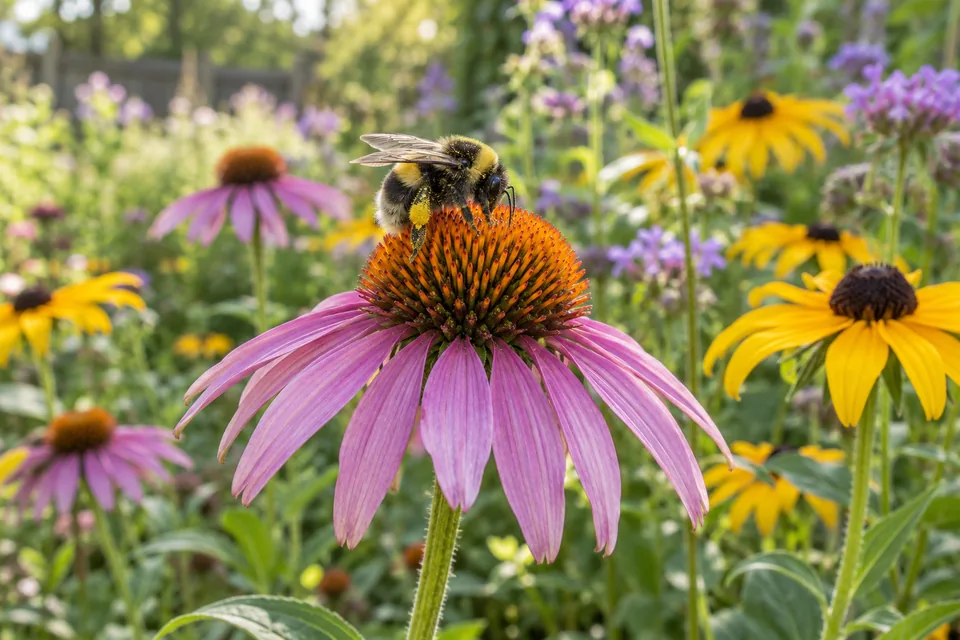
Use flowers with different architectures: open daisy-like disks for short-tongued insects, shallow clusters for flies and small bees, and tubes for long-tongued bees, butterflies, and moths. Rodale Institute's insectary guidance also calls for varied color, plant height, and bloom period so one planting serves beneficial insects with different bodies and seasonal schedules.
Pay particular attention to the shoulders. Very early bloom supports queens emerging from hibernation and the first solitary species; late bloom carries bumble bee colonies through their reproductive push. Add abundant fall bloom to relieve the late-season forage shortage. Goldenrods and asters do a great deal of work here.
Include host plants, not only nectar plants. A garden that feeds adult butterflies but supports no caterpillars is a filling station, not habitat — and the caterpillar hosts are also what feeds nesting birds.
Provide shelter and nesting space
Roughly 70 percent of native bee species nest in the ground, in burrows just beneath the surface, and about 30 percent nest in cavities — hollow or pithy stems, old beetle borings, and similar tunnels. Almost all pollinator gardening advice concerns flowers; nesting is where a garden usually fails.
Ground nesters need actual bare ground
They need loose, undisturbed soil with genuinely bare patches — not dense vegetation, and not a blanket of mulch. Two common landscape choices block them completely: landscape fabric, which creates an impenetrable layer, and heavy, dyed, or chemically treated wood mulch. Leave deliberate sunny, well-drained patches free of both. Where some ground cover is wanted, a shallow layer of pebbles works better than wood chips, since bees can still reach soil between the stones.
Distribute several open patches through the planting, keep them sunny and undisturbed, and do not mulch wall to wall.
Stems: a cycle longer than one year
Cut dead perennial stems back in spring to a stubble of varying height, roughly 8 to 24 inches (20 to 60 cm). New growth hides the stubble, and cavity-nesting bees nest in the freshly cut ends through the season.
Use dispersed natural nests instead of a large bee hotel
The largest field test — roughly 600 bee hotels over three years in Toronto, with more than 27,000 bees and wasps recorded — found that native wasps were significantly more abundant than bees and occupied about three-quarters of hotels each year. Introduced bee species made up nearly half of all bees recorded. Native bees in those hotels were parasitized more than introduced bees were.
Aggregation itself raises risk. Densely clustered nests are easier targets for parasites than dispersed natural nests. Favor standing stems, pithy canes, beetle holes in sound deadwood, and small blocks placed apart. If a hotel is already installed, follow NC State Extension's cleaning and replacement schedule every season.
Standing stems, undisturbed ground, brush piles, snags where they are safe, and leaf litter left in place all provide the same resources without concentrating them.
Offer water without creating a trap
Provide shallow water with secure footing: a dish with pebbles or coarse sand breaking the surface, or a damp patch of bare soil, which also gives butterflies and mason bees the mud and minerals they use. Refresh it at least twice a week so it cannot complete a mosquito breeding cycle, and scrub it when you do. Skip deep, steep-sided containers.
Reduce pesticide risk
The least-disruptive sequence applies here as everywhere: choose adapted plants, accept some feeding damage, tolerate the aphids that feed the predators, remove problems by hand, and treat only a confirmed problem — never on a calendar. If a pesticide is genuinely necessary, choose the most selective option, follow the label, avoid blooming plants, and apply when pollinators are not active and wind will not carry it.
Ask how nursery plants were treated
This is the part that most pollinator articles omit, because it is not about what you spray. Systemic neonicotinoids — imidacloprid, thiamethoxam, clothianidin — move into plant tissue and can remain active for months to years after a single application. Soil half-lives vary enormously by site and can exceed 1,000 days, so repeated use accumulates.
Nursery and landscape application rates are far higher than agricultural seed treatment. In one study, greenhouse and nursery application to flowering plants produced flower residues roughly 800 to 1,400 times higher than an agricultural seed treatment, and a second application seven months later raised residues in treated ornamental milkweed several times again — direct evidence that residue accumulates across seasons in a container plant.
The biological result in that study is the detail worth carrying: for monarch and painted lady butterflies, adult survival was not reduced, but larval survival was significantly reduced. A treated plant can look like it is working — adults visiting, flowers busy — while failing the caterpillars it was bought for. Soil-level exposure also affects solitary bees sublethally, which matters when most of them are nesting in that soil.
So ask the nursery directly: were these plants, or the plugs they came from, treated with any systemic insecticide, and if so which one and when? "We don't spray" is not an answer to that question, because the treatment may have been applied upstream by the propagator. Nurseries that can answer clearly are worth returning to.
Mosquito spraying services
Subscription mosquito spraying is the highest-volume broad-spectrum insecticide application in many residential neighborhoods. In one residential assessment, every yard sprayed by a private mosquito-control company carried pyrethroid residues at levels high enough to kill bees and other beneficial insects — and 75 percent of samples from neighboring, unsprayed yards were contaminated too. Several butterfly species are more sensitive to these insecticides than honey bees are, so timing advice built around honey bees does not automatically protect them.
If a neighbor uses such a service, the drift finding is worth a conversation. If you are considering one, source reduction — emptying standing water weekly, managing gutters and containers — targets the larvae without treating the whole yard.
Monarchs: plant the right milkweed
"Plant milkweed for monarchs" is incomplete to the point of being harmful, because of which milkweed garden centers sell.
Tropical milkweed (Asclepias curassavica) does not die back in mild-winter regions. Native milkweeds do, and that annual dieback clears the protozoan parasite Ophryocystis elektroscirrha — OE — from the foliage. On persistent tropical milkweed, spores deposited by visiting adults accumulate and caterpillars ingest them. Monarchs breeding on tropical milkweed through winter carry higher OE loads; infection reduces migration success, body mass, lifespan, mating success, and flight performance.
The instruction, then, is to plant the Asclepias species native to your region, using the ecoregion lookups above. If tropical milkweed is already growing in a mild-winter garden, the standard mitigation is to cut it hard to the ground in late autumn; disinfect tools between plants so you do not spread spores.
As of September 2, 2026, the monarch is not federally protected under the Endangered Species Act. The US Fish and Wildlife Service proposed listing it as threatened in December 2024, together with a section 4(d) rule and critical habitat for western overwintering sites in California, but has not issued a final rule. Check the Service's monarch page before relying on that legal status.
Don't forget the night shift
Moths are a large and under-counted part of the pollination network. In one study, 381 of 838 moths sampled — about 46 percent — carried pollen from 47 plant species, including at least seven rarely visited by bees, hoverflies, or butterflies. Pollen sat most often on the underside of the thorax rather than the proboscis, which is why casual observation misses it. Adult moths also move pollen between plantings farther apart than the foraging range of many nest-bound bees.
Artificial light works directly against them. A field experiment using mobile street lamps in Swiss meadows found nocturnal pollinator visitation fell by 62 percent under artificial light, and fruit set of a focal plant dropped 13 percent — and daytime pollinators did not compensate for the loss. Light also disrupts daytime plant–pollinator interactions, so the effect is not confined to the hours the lamp is on.
This is unusually actionable. Shield fixtures so light goes down rather than out, use warmer color temperatures and lower output, put outdoor lighting on motion sensors rather than dusk-to-dawn operation, and skip decorative landscape uplighting near planted areas.
Replace a no-mow month with permanent habitat
Do not rely on No Mow May. The study used to support the campaign was retracted in 2022 for problems in data handling and reporting, and a single month without mowing does not provide stable nesting or forage. An abrupt June cut also removes flowers and the insects using them.
Bee lawns are the better-evidenced alternative. University of Minnesota research found Dutch white clover and self-heal (Prunella vulgaris var. lanceolata) worked best in flowering lawns, with more than 60 bee species using them; self-heal draws both bumble bees and very small bees that fit inside the flower. Creeping thyme was originally recommended and has since been dropped from the mixture on the basis of long-term observation and seed availability — a useful reminder that this advice is still developing. Trials found roughly 200 seeds per square foot worked well for overseeding an existing lawn.
Converting turf area to planted beds does more than either approach, and it removes the mowing question entirely.
Seed mixes and getting established
A "wildflower mix" is how most beginners start and a common way beginner plantings fail. Much wildflower seed is sold as uncertified or "common" seed, meaning it is not screened for contaminant species and the geographic origin is unknown — a University of Washington study found commercial mixes contaminated with weed species, and while that particular study is old, the finding has been repeated since.
The vetting rule is simple: require a complete species list with botanical names before you buy. Some vendors publish the list only on their website rather than the packet, so check there. If no botanical-name list exists anywhere, do not buy the mix. Buying single-species packets and blending your own eliminates the problem entirely and lets you match the list to your ecoregion lookup.
A seeded planting spends its first year putting down roots and looking like weeds; plugs and potted plants cost more and skip that stage. Prepare the site completely, water through the first season even for drought-tolerant natives, and mark the seeded area so it is not disturbed. From the second season onward, inspect throughout active growth and remove invasive plants before they flower or set seed. Use your state Extension wildflower guide for local sowing dates.
A note on honey bees
"Save the bees" usually means honey bees, and a pollinator garden is the right place to separate the two. The honey bee is a managed livestock species, not a wild one at risk of extinction.
Do not add honey-bee hives as a wildlife-conservation measure. A hive adds tens of thousands of managed foragers to the landscape, while small-bodied native bees have short foraging ranges and few alternative patches. Protect wild bees by expanding pesticide-free native forage—especially late-season bloom—and by providing nesting habitat.
Maintain habitat, not a display
Aggressive tidiness is the main way a well-planted garden fails as habitat. Leave leaf litter in beds. Leave seed heads. Leave stems, on the two-season cycle described above. Stagger cleanup across the garden so no area is ever stripped bare at once.
On spring timing, one popular rule deserves retirement: wait until it has been 50°F for seven consecutive days. It circulates widely and has no identifiable authoritative source. It is also unfollowable in principle, since nobody agrees whether the threshold means daily highs, overnight lows, or a mean — and a one-week warm spell does not mean overwintering insects have completed their life cycles. Xerces' own published guidance is a regional date window rather than a thermometer rule; for northern states it suggests mid-to-late April as the earliest to consider cutting back perennials and clearing debris.
Manage the garden as a multi-year habitat with overlapping life cycles. Cut some stems, leave others, and stagger cleanup so intact shelter always remains.
Habitat also improves with company. Three neighboring gardens with continuous bloom and undisturbed ground are worth far more than one excellent garden surrounded by mown, sprayed turf — which, given foraging ranges of a few hundred feet, is not a sentiment but a measurement.
Sources and further reading
- Rodale Institute: Insectary strips field guide — varied flower forms, colors, and bloom periods for beneficial insects.
- Rodale Institute: Pollinator seed mix for agricultural properties — establishment and long-term invasive-plant monitoring.
- Xerces Society: Nesting resources — the ground-nesting share and habitat requirements.
- Xerces Society: Tunnel nests for native bees — cavity nesters.
- Xerces Society: Nesting and overwintering habitat — stubble heights and the multi-season stem cycle.
- Xerces Society: Don't spring into garden cleanup too soon — regional timing rather than a temperature rule.
- Utah State University Extension: Gardening for native bees — bare ground and landscape fabric.
- Bee City USA: Why pollinators need access to bare ground.
- Journal of Hymenoptera Research: Foraging distances of small solitary bees.
- Greenleaf et al., Oecologia: Bee foraging ranges and their relationship to body size.
- Narango, Tallamy & Shropshire, Nature Communications: Few keystone plant genera support the majority of Lepidoptera species.
- National Wildlife Federation: Keystone plants by ecoregion.
- Pollinator Partnership: Ecoregional planting guides.
- Annie White, University of Vermont: Native species versus cultivar pollinator trials.
- Mt. Cuba Center: Trial garden results — the Monarda and Phlox pollinator trials.
- Krischik et al., PLOS ONE: Soil-applied imidacloprid in ornamentals and effects on beneficial insects — nursery residue levels and reduced larval survival.
- Environmental fate and exposure review of neonicotinoids — persistence and soil half-lives.
- Xerces Society: Mosquito sprays may kill pollinators and drift into neighboring yards.
- MacIvor & Packer, PLOS ONE: "Bee hotels" as tools for native pollinator conservation — a premature verdict?
- NC State Extension: What if bee hotels aren't actually good for bees?
- University of Minnesota Extension: Is tropical milkweed bad for monarchs?
- Monarch Joint Venture: Research on tropical milkweed and monarch parasites.
- US Fish and Wildlife Service: Monarch butterfly proposed for ESA protection — check here for current status.
- University College London: Moths have a secret but vital role as pollinators at night.
- Knop et al., Nature: Artificial light at night as a new threat to pollination — the 62 percent visitation decline.
- Oregon State University Garden Ecology Lab: The controversy surrounding No Mow May.
- University of Minnesota Extension: Planting and maintaining a bee lawn.
- Oregon State University Extension: The impact of beekeeping on native bees in urban settings.
- Colorado State University Extension: Wildflower seeding — uncertified seed and vetting mixes.