Start with observation and a laboratory soil test, then use the result to choose the work: protect structure, correct a documented nutrient or pH problem, keep living roots in the ground, and cover bare soil.
One theme runs through all of it. Soil changes slowly, and the interventions that work are unglamorous. If a product promises to transform your soil in a season, that claim is the thing to check first.
The parts of a functioning soil
Soil is roughly half solid and half pore space, and both halves matter. The mineral fraction — sand, silt, and clay — sets the baseline behavior. Organic matter is usually a small percentage by volume but influences far more than its share. The pore space holds water and air in competition: fill it all with water and roots suffocate; drain it all and they desiccate.
Three terms get blurred together constantly, and separating them is the foundation for everything else:
- Texture is the proportion of sand, silt, and clay. It is essentially fixed. You cannot amend your way from clay to loam at garden scale, and attempting it with sand usually makes things worse.
- Structure is how those particles aggregate into crumbs and how those crumbs arrange themselves. It is what you can actually change, and it is what determines drainage, aeration, and root penetration.
- Tilth is the working description of a soil in good condition — friable, crumbly, easy to plant into.
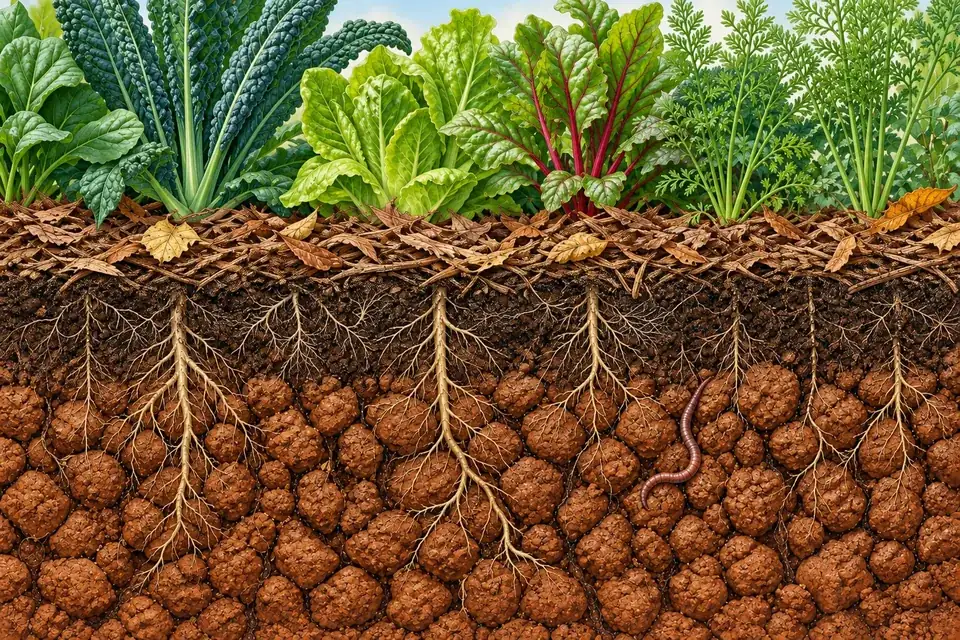
Aggregate stability is what holds structure together: fungal hyphae, root exudates, and microbial polysaccharides bind particles into crumbs that survive wetting. That is why living roots and organic matter improve soil, and why repeated tillage and working wet soil degrade it.
Start with direct observation
Before buying anything, spend twenty minutes learning what you have.
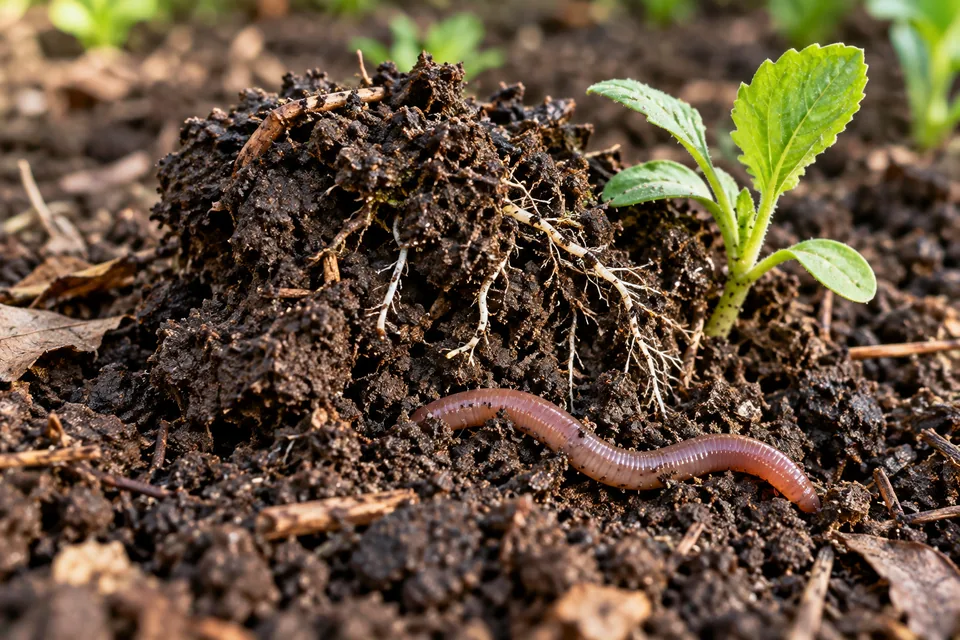
Dig a hole. A foot deep, ideally after rain. Look for the depth of darker topsoil, where roots stop, layers that change abruptly, standing water, and how the soil breaks apart in your hands. Good structure crumbles into rounded aggregates; poor structure comes out in dense blocks or single grains.
The ribbon test gives you texture. Moisten a ball of soil and squeeze it upward between thumb and fingers so a ribbon of uniform thickness extends over your forefinger until it breaks under its own weight:
| Ribbon length | Texture class |
|---|---|
| Will not ribbon at all | Sand or loamy sand |
| Less than 1 inch | Loam, silt, silty clay loam, or clay loam |
| 1 to 2 inches | Sandy clay loam, silty clay loam, or clay loam |
| More than 2 inches | Sandy clay, silty clay, or clay |
The ball squeeze test is a quicker version: coarse soils break under slight pressure, medium soils hold together but change shape easily, and fine soils resist breaking.
The jar test gives a useful visual estimate. Fill a jar a third full with sifted soil, add a teaspoon of detergent or a dispersant, fill nearly to the top with water, and shake vigorously for at least five minutes. Mark the sand layer at 1 minute, the silt layer at 2 hours, and the clay layer at 2 days. Use the result to see the three fractions, not to assign a laboratory texture class; jar tests systematically underestimate clay.
The workability test is the one that prevents lasting damage. Squeeze a handful: if it forms a sticky ball that smears rather than crumbling, the soil is too wet to work. Working wet clay destroys structure in a way that takes years to rebuild.
Finally, look up your own soil. The USDA Natural Resources Conservation Service's Web Soil Survey lets you find the mapped soil series for your property and read its documented characteristics — drainage class, depth, texture, and typical limitations. It describes the native soil rather than the fill in a suburban yard, but it is a useful starting point.
Take a soil sample that means something
A soil test is cheap and is the only way to know your pH and nutrient status. But a bad sample produces a confidently wrong report, and bad sampling is why many home tests mislead.
Take a composite. Collect 15 to 20 cores from random spots across the area, mix them thoroughly in a clean bucket, and submit about a pint of the mixture. For areas under 100 square feet, 5 to 10 subsamples are adequate.
Sample to the right depth, which depends on use: 6 to 8 inches for flowers, vegetables, and small fruits, with 6 inches widely accepted as the zone of highest root density; 2 to 3 inches for lawns; and about 6 inches around the dripline for trees and shrubs.
Sample separately for areas that differ. A composite across a lawn and a vegetable bed produces an average that describes neither. Avoid sampling right after liming or fertilizing, and keep the bucket and tools clean — a galvanized bucket will skew a zinc reading.
Use your state Cooperative Extension lab where you can. Their recommendations are calibrated to your region's soils and crops, which a generic mail-order test is not.
Read the report
Four things on a typical report cause the most confusion.
pH and buffer pH are different measurements. Soil pH is the "active" acidity — the actual reading. Buffer pH measures the reserve acidity held on soil particles, and it is what determines how much lime is actually required. This is why you cannot compute a lime rate from pH alone, and why two soils reading pH 5.8 can need very different amounts.
Phosphorus and potassium are reported as an index from a specific extraction method — Bray, Mehlich-3, and Olsen among them. The number is only interpretable against that lab's own recommendations for that method. Do not compare P and K values between labs, and do not apply another region's thresholds to your report.
Cation exchange capacity (CEC) measures the soil's capacity to hold and release nutrient cations. It is largely a function of texture and organic matter, so it is not something you freely choose; sandy soils will always have a low CEC. Adding organic matter raises it modestly over time.
Nitrogen is usually not reported at all, and this surprises people. Nitrogen is too mobile in soil for a lab result to be useful by the time you read it. Nitrogen recommendations are instead based on the crop, the previous crop, and yield expectations. If you want to know whether nitrogen is limiting, the plants will tell you faster than a lab will.
Change pH in the direction that is actually possible
Raising pH with lime is routine. Lowering it is a different proposition, and the asymmetry is worth understanding before you buy anything.
Elemental sulfur does not acidify soil directly. Microbes oxidize it to sulfuric acid, which takes three to six weeks or longer, and finer grinds convert faster. Because the process is biological, it stalls in cold or dry soil.
Then there is buffering. The more calcium carbonate a soil contains, the harder it resists. Neutralizing a soil with just 2 percent calcium carbonate takes roughly 6 tons of sulfur per acre — which is not a garden-scale intervention. Extension services put it bluntly: in soils containing naturally occurring lime, lowering pH is "difficult to impossible, cost prohibitive, and thus impractical."
pH matters because it governs availability rather than supply. Above roughly pH 7, iron binds tightly and becomes chemically unavailable even when abundant — which is why adding iron to an alkaline soil does not fix iron chlorosis. Most vegetables and ornamentals do well somewhere in the range of pH 6.0 to 7.0, but check your specific crops before adjusting anything.
Build soil with roots, cover, compost, and less disturbance
Organic matter improves aggregate stability, feeds soil life, buffers pH, holds nutrients, and improves infiltration. Rodale Institute's Farming Systems Trial has measured the combined result over more than forty years: organic systems built more soil organic matter and microbial biomass, reduced compaction, and moved water into the soil faster. In drought years, corn yields in those systems were 31 percent higher than in the conventional comparison.
Do not turn that result into a fixed water-storage promise for an individual garden. A meta-analysis of 60 studies and more than 50,000 measurements found that added organic carbon usually increased water content by 0.7 to 2 millimeters per 100 millimeters of soil depth for each 1 percent increase in carbon, with a larger response in silty loam than in sand. The reliable gains are better aggregation, intake, root growth, and resilience; the exact change in stored water follows the soil's texture and depth.
How to build it, in order of usefulness:
- Keep living roots in the ground as much of the year as possible. Cover crops and perennials feed soil biology directly through root exudates in a way that applied material cannot.
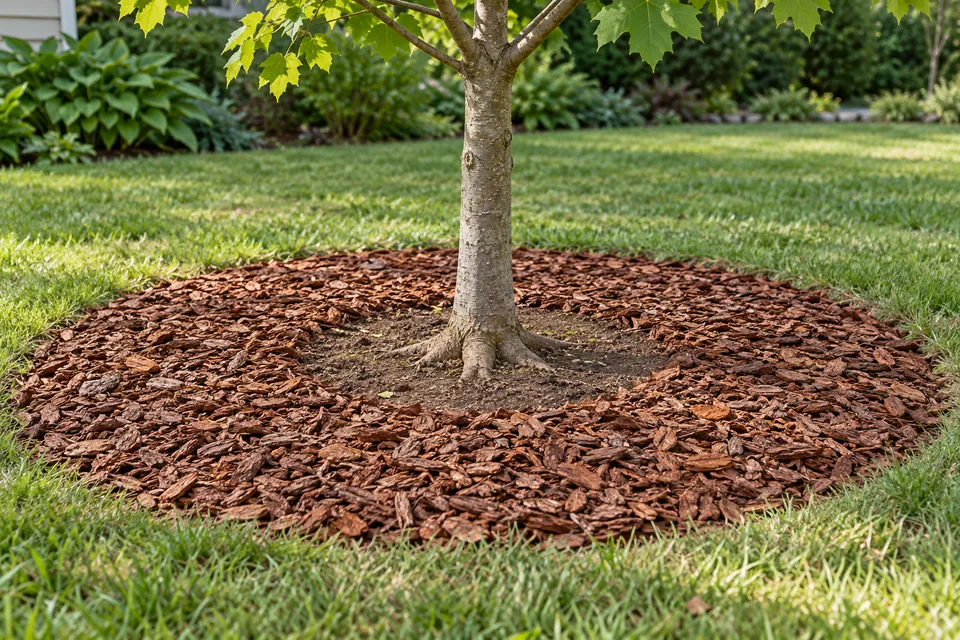
- Keep the surface covered. Mulch moderates temperature, prevents crusting and erosion, and decomposes into the surface soil — which is how soils build naturally, from the top down.
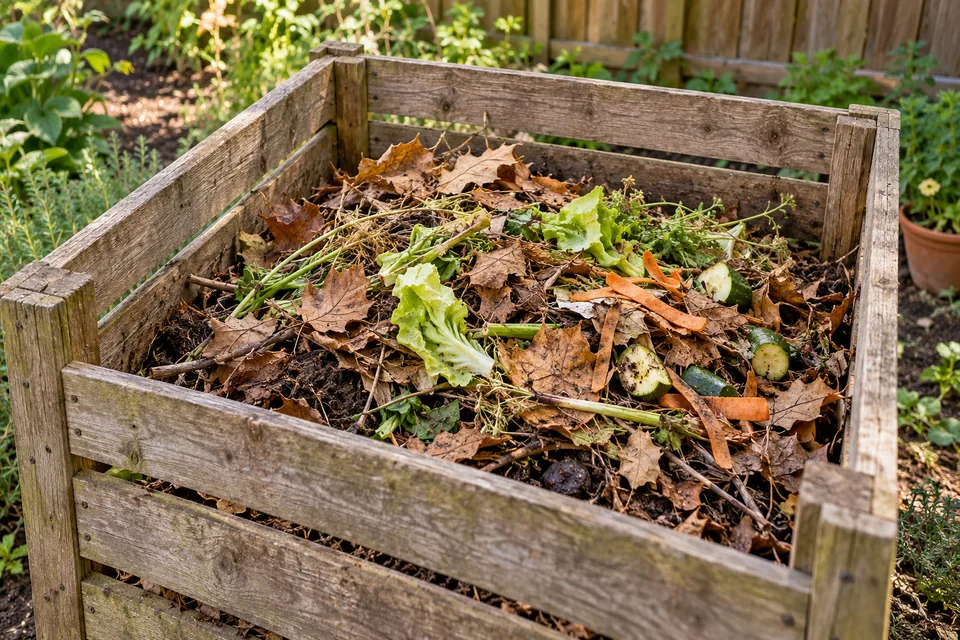
- Add compost at maintenance rates, not maximum rates. Repeated heavy applications accumulate phosphorus and soluble salts that do not readily leave. See our composting guide for rates and the accumulation problem.
- Disturb less. Every tillage event accelerates organic matter oxidation and breaks the aggregates you are trying to build.
Expect slow progress. Organic matter tends toward an equilibrium set by climate, texture, and management, and moving it a percentage point is a multi-year project, not a season's work.
Address compaction by cause
Compacted soil resists roots, sheds water, and stays wet after rain because water cannot move down through it. But "compaction" covers several different problems with different fixes, and treating them alike wastes effort.
If your site combines dense structure with a high clay content, use our complete no-till guide to improving heavy clay soil for diagnosis, bed conversion, mulch, cover crops, and a year-round plan.
- Surface compaction from foot and equipment traffic. The fix is traffic management — permanent beds and paths so you never step on growing soil — plus surface organic matter and time.
- A tillage pan at the depth of repeated cultivation. Deep-rooted cover crops and a broadfork help; more tilling makes it worse.
- A naturally dense subsoil horizon, which is a soil property rather than damage. Raised beds and species selection work better than trying to change it.
- Sodium-dispersed soil, where structure collapses chemically. This is the one case where gypsum genuinely helps — and only this case. Gypsum is not a general soil conditioner.
Diagnose before treating. Push a wire flag or a long screwdriver into moist soil across the bed: a consistent depth at which it suddenly resists tells you where the restrictive layer is, and whether it is at traffic depth or tillage depth. Water ponding, and roots that flatten and run sideways rather than down, corroborate it. Laboratory bulk density measurements exist and NRCS publishes reference material on them, but the flag test is what you can actually do on a Saturday.
Test for lead before growing food on an older urban site
Test food-garden soil near pre-1978 painted structures, former industrial land, and roads that carried heavy traffic during the leaded-gasoline era. State Cooperative Extension laboratories offer lead and heavy-metal panels and can interpret the result for local background levels.
Use current numbers for the right purpose. EPA's October 2025 directive sets 200 ppm as the residential soil lead screening level and 600 ppm as the removal-management level at federal Superfund and RCRA hazardous-waste cleanup sites. These are investigation and cleanup-management values, not universal garden-soil standards. When contaminated residential soil is present, EPA recommends filling food-garden raised beds with clean topsoil containing no more than 50 ppm lead. Take any result at or above 200 ppm to your Extension service or local health department for site-specific action.
The exposure pathway is the part that changes what you do. The dominant route is soil and dust contact and ingestion, not uptake into the plant. So the protective measures are as much about the gardener as the crop:
- Grow food in containers or raised beds over a barrier, filled with verified clean topsoil and compost to a depth of at least 8 inches.
- Keep soil pH near 6.5, which reduces plant uptake.
- Mulch paths and bare ground to suppress dust.
- Wash produce thoroughly, peel root crops, and remove outer leaves.
- Wash hands after gardening, and keep garden shoes outside.
Soil life, including the worm that is not good news
Soil biology is real and important, and it is also where the most overselling happens. A gardener can support it reliably by doing three unglamorous things: keeping roots in the ground, keeping the surface covered, and disturbing less. There is no home test that measures soil biological function in a way that should drive a purchase.
One biological change does warrant attention. Invasive jumping worms — three similar-looking non-native species, Amynthas tokioensis, Amynthas agrestis, and Metaphire hilgendorfi — are spreading through gardens and forests and genuinely alter how soil behaves.
Identification: they thrash violently, snake-like, when disturbed; they are 1.5 to 8 inches long at maturity with smooth, glossy skin; and the clitellum is a pale whitish band that encircles the body smoothly, rather than the raised, saddle-like band of a European earthworm. The clearest sign is the castings, which have the texture and appearance of coffee grounds.
What they do: they consume the organic layer and leave granular castings behind. The resulting soil is more porous, so water moves through quickly and moisture content drops. In home gardens this diminishes the growth of annuals, perennials, and turf.
What to do: there are currently no proven control methods once they are established, so prevention is the entire strategy. Use only reputably sourced soil and heat-treated compost and mulch, clean tools and boots between sites, and do not move soil or plants between gardens. Adults found can be killed by dropping them in soapy water. Some states regulate the movement of soil and plant material, so check your state rules before moving material between properties.
Skip amendments that do not solve a diagnosed problem
Mycorrhizal inoculants. Skip them on routine transplants. Most landscape soils already contain the fungi, unsuitable site conditions prevent establishment, and tests of commonly available consumer products found that more than half were not viable.
Compost tea. The published literature is thin: on the order of 34 papers on non-aerated tea and 7 on aerated tea, with variable results and field tests showing no effectiveness. A WSU extension horticulturist who has followed the research for around fifteen years, and run some of her own, finds few studies with positive results. None of five manufacturers surveyed provided evidence on their websites that their product works.
Gypsum is genuinely useful on sodic soils and does nothing for ordinary clay. Sand added to clay in garden quantities generally makes structure worse, not better. Epsom salts address magnesium deficiency, which a soil test can confirm and which is uncommon; applying them without that confirmation adds salt for no reason.
Spend the same budget on a soil test, clean compost, mulch, or cover-crop seed. Each one solves a defined soil-management job.
A realistic improvement plan
Soil improvement is a multi-year project with a short annual to-do list.
Year one: test the soil, including lead if you are in an urban or older residential setting. Establish permanent beds and paths so you stop compacting the growing area. Correct pH if the test calls for it — and check the vinegar test before attempting to lower it. Mulch everything.
Year two: add compost at maintenance rates. Introduce a cover crop in at least one bed to see how it fits your schedule. Reduce tillage to what a specific job actually requires. Keep notes on where water stands and where plants struggle.
Year three and onward: retest and compare. Expect pH and phosphorus to have moved and organic matter to have barely budged — that is normal, not failure. Adjust based on what the test and the plants both say.
Judge progress by behavior rather than by numbers alone: how quickly water soaks in, how the soil breaks in your hand, how deep roots go, how long beds stay workable after rain, and whether plants recover from stress faster than they used to. Those improve before any single figure on a report does.
Sources and further reading
- Rodale Institute: Soil health — soil cover, living roots, biodiversity, and reduced disturbance.
- Rodale Institute: Farming Systems Trial — long-term results for soil organic matter, compaction, infiltration, and drought-year yields.
- Rodale Institute: The role of regenerative organic agriculture in a changing climate — measured water infiltration and root-zone water across long-running field systems.
- Colorado State University Extension: Estimating soil texture — the ball squeeze test.
- Colorado State University Extension, CMG GardenNotes #214: Estimating soil texture — ribbon lengths by texture class.
- Oregon State University Extension: Analyze your garden soil with the jar test — and its stated tendency to underestimate clay.
- Clemson Cooperative Extension: Soil texture analysis, the jar test.
- Penn State Agricultural Analytical Services Lab: Soil sampling instructions — composite sampling.
- University of Missouri Extension: Soil sampling depth and collection techniques.
- Cornell Cooperative Extension: How to take a soil sample.
- University of Maryland Extension: Understanding your soil test report — pH versus buffer pH, and CEC.
- Virginia Cooperative Extension: Explanation of soil tests — why nitrogen is not reported.
- Clemson Land-Grant Press: Interpreting routine soil tests — extraction methods and comparability.
- Utah State University Extension: Managing soil pH in calcareous and alkaline soil — the vinegar free-lime test and sulfur requirements.
- Ohio State University Extension: Soil acidification — how to lower soil pH.
- Colorado State University Extension: Changing soil pH.
- University of Minnesota Extension: The connection between soil organic matter and soil water.
- Minasny & McBratney, European Journal of Soil Science: Limited effect of organic matter on soil available water capacity — the meta-analysis.
- Iowa State University: Where do you hide 20,000 gallons of water? — scrutiny of the popular figure.
- UF/IFAS Extension: Raising soil organic matter content to improve water holding capacity.
- USDA NRCS: Bulk density, soil health guide.
- USDA NRCS: Soil compaction.
- US EPA: 2025 Residential Soil Lead Directive — current screening and removal-management levels for federal cleanup sites.
- US EPA: Lead at Superfund sites, frequent questions — clean raised-bed fill for food gardening.
- University of Georgia Extension: Urban gardening — assessing soils for contamination — action guidance by lead level.
- Rutgers NJAES: Soil testing for lead contamination.
- University of Maryland Extension: Lead in garden soils.
- Michigan State University Extension: Lead safety for the home garden.
- University of Minnesota Extension: Jumping worms — identification and prevention.
- University of Maryland Extension: Invasive jumping worms.
- Penn State Extension: Adapting to invasive jumping worms — effects on soil porosity and moisture.
- UConn Integrated Pest Management: Jumping worms.
- UC Agriculture and Natural Resources: Mycorrhizal inoculants — unproven efficacy and product viability.
- Washington State University: Literature on compost tea and disease suppression.